
Acne Pigmentation Treatment in Coimbatore | EverGlo
Acne Pigmentation Treatment in Coimbatore: Why Dark Marks Stay After Acne
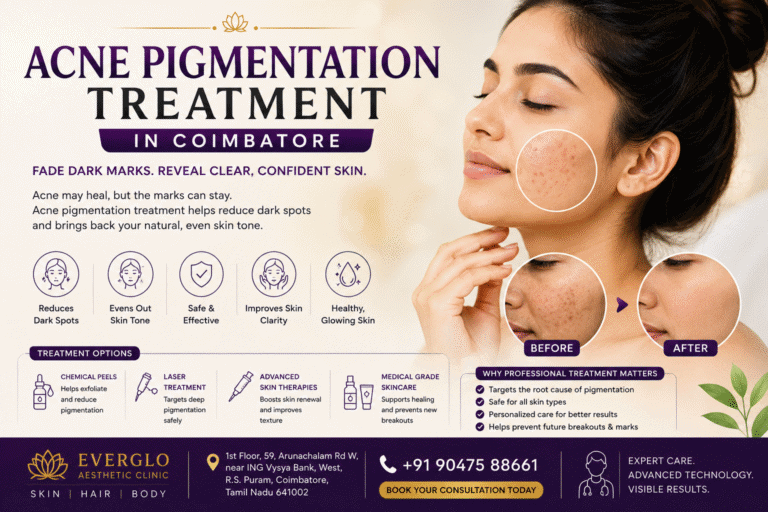
Acne can leave behind a reminder even after the pimples are gone. You may notice brown, black, or reddish marks where an acne spot was previously present. These marks can make the skin look uneven and may take a long time to disappear.
This is commonly known as post-acne pigmentation or post-inflammatory pigmentation.
It is different from an acne scar. A scar changes the texture of the skin, while pigmentation mainly changes the colour. The skin may still feel completely smooth, but the dark mark remains visible.
For people looking for acne pigmentation treatment in Coimbatore, understanding why these marks develop is an important first step.
Why Does Acne Leave Pigmentation?
When a pimple develops, the skin becomes inflamed. This inflammation can stimulate the production of melanin, the pigment responsible for skin colour.
After the acne settles, the extra pigment may remain in that particular area. This is why you may see a dark spot even though there is no longer a pimple.
The more inflamed the acne is, the more likely it may be to leave a noticeable mark.
Trying to squeeze or pick pimples can also make the problem worse. It can increase inflammation and may increase the chance of both pigmentation and scarring.
Why Do Some People Get More Dark Marks?
Everyone’s skin responds differently to acne.
Some people may notice that their pimples disappear without leaving much of a mark. Others may develop pigmentation after even a small breakout.
Skin tone can also influence how noticeable post-acne pigmentation becomes. People with medium to darker skin tones can be more prone to developing pigmentation after inflammation.
Sun exposure can make existing marks look darker as well. This is one reason why daily sun protection is an important part of managing pigmentation.
Acne Marks or Acne Scars?
It is easy to confuse the two.
If you have a flat brown or dark spot where a pimple used to be, it is more likely to be pigmentation.
If you notice a depression, uneven surface, or raised area, it may be an acne scar.
Some people have both. For example, an old acne breakout may leave a dark mark along with a small depression in the skin.
Because the treatment can be different, identifying the actual problem before starting treatment is important.
Will Acne Pigmentation Go Away on Its Own?
Some pigmentation can gradually become lighter without professional treatment.
However, the process can be slow. Depending on the skin and the depth of the pigmentation, a mark may remain visible for several months.
New acne can also create new marks while older ones are still fading. This can make it feel as though the pigmentation is never improving.
For this reason, managing active acne is just as important as treating the pigmentation that is already present.
What Can Make Acne Pigmentation Worse?
Certain everyday habits can make dark marks more noticeable.
Picking or squeezing pimples is one of the common mistakes. It can increase inflammation and cause additional skin damage.
Using too many strong skincare products can also irritate the skin. Scrubbing the face frequently does not remove pigmentation faster and may actually make sensitive skin more irritated.
Sun exposure is another important factor. UV exposure can encourage pigmentation and make existing dark spots appear deeper.
A simple and consistent skincare routine is usually better than constantly changing products.
How Is Acne Pigmentation Treated?
There is no single treatment that works for every type of pigmentation.
The first step is to understand the skin and determine whether the concern is mainly pigmentation, active acne, acne scars, or a combination of these.
For mild pigmentation, a suitable skincare routine may sometimes be enough. Depending on the skin, certain ingredients can be recommended to support skin renewal and improve uneven pigmentation.
When pigmentation is more persistent, professional treatments may be considered.
Chemical Peels for Acne Pigmentation
Chemical peels are one option that may be used for certain types of superficial pigmentation.
A carefully selected peel works on the outer layers of the skin and encourages the skin to renew itself. Over time, this can help improve uneven-looking skin tone.
The type of peel matters. A treatment should be selected according to the person’s skin type, pigmentation and sensitivity.
A stronger peel is not automatically a better peel. Treating the skin too aggressively can cause irritation and may lead to more pigmentation.
Laser Treatments for Dark Marks
Certain laser treatments may also be considered when pigmentation does not respond sufficiently to skincare.
However, laser treatment is not suitable for every type of pigmentation. The cause of the pigmentation, skin type and previous treatments should be considered before choosing a laser.
A professional assessment can help determine whether laser treatment is appropriate or whether another option would be safer and more suitable.
What About Acne Scars?
If pigmentation is accompanied by uneven or depressed skin, treating only the pigmentation may not be enough.
Acne scars affect the structure and texture of the skin. Treatments such as microneedling or certain laser procedures may be considered depending on the type of scar.
This is why a consultation can be useful. Two people may both say they have “acne marks”, but one may mainly have pigmentation while the other may have pigmentation along with acne scars.
Daily Care Still Matters
Professional treatment is only one part of improving acne pigmentation.
Protecting the skin from the sun is especially important. Regular sunscreen use can help prevent pigmentation from becoming darker and can support the results of pigmentation treatment.
A gentle cleanser and moisturiser can help maintain the skin barrier. Avoiding unnecessary scrubbing and picking can also reduce irritation.
If you are already using active skincare products, it is better to introduce treatments carefully rather than combining several strong products at the same time.
What If Acne Keeps Coming Back?
If new acne continues to appear, treating only the old marks may not solve the overall problem.
Every new inflamed pimple can potentially leave another dark mark. This can create a cycle where old pigmentation is fading while new pigmentation is developing.
For this reason, an acne treatment plan may need to be combined with pigmentation care.
The aim is to reduce new breakouts while gradually improving the marks that are already present.
When Should You Consider Professional Treatment?
You may want to consult a skin professional if your pigmentation has remained for a long time, keeps becoming darker, or is affecting your confidence.
Professional advice can also be useful if you have frequent acne, painful pimples, acne scars, or pigmentation that does not improve with your regular skincare routine.
Instead of trying multiple products without knowing the cause, a skin assessment can help you understand what your skin actually needs.
Acne Pigmentation Treatment in RS Puram, Coimbatore
People looking for acne pigmentation treatment in Coimbatore may have different types of marks and different skin concerns.
At EverGlo Aesthetic Clinic – RS Puram, the skin can be assessed before deciding on a treatment approach. Depending on the condition, options such as skincare, chemical peels, laser treatments, or other suitable procedures may be discussed.
The treatment approach should be based on the person’s skin rather than using the same procedure for every pigmentation concern.
Clearer-Looking Skin Takes Time
Acne pigmentation usually does not disappear in a few days. Skin needs time to renew itself, and results can vary depending on the depth of the pigmentation and the individual’s skin.
The most useful approach is to combine appropriate treatment with consistent daily care.
Avoid picking acne, protect your skin from excessive sun exposure, follow a suitable skincare routine, and give the skin enough time to respond.
Final Thoughts
Dark marks after acne can be frustrating, especially when the original pimples have already disappeared. But pigmentation does not mean that your skin cannot improve.
Understanding whether you have pigmentation, acne scars, active acne, or a combination of concerns is the first step.
If you are dealing with persistent acne pigmentation, professional guidance can help you understand the cause and choose a treatment approach that is suitable for your skin.
Book Your Consultation Today
If you are concerned about acne pigmentation or dark spots after acne, a professional skin consultation can help you understand the available treatment options.
EverGlo Aesthetic Clinic – RS Puram, Coimbatore
Address:
1st Floor, 59, Arunachalam Rd W, near ING Vysya Bank, West, R.S. Puram, Coimbatore, Tamil Nadu 641002
Contact: +91 90475 88661
Book your consultation today and take the first step towards clearer, more even-looking skin.